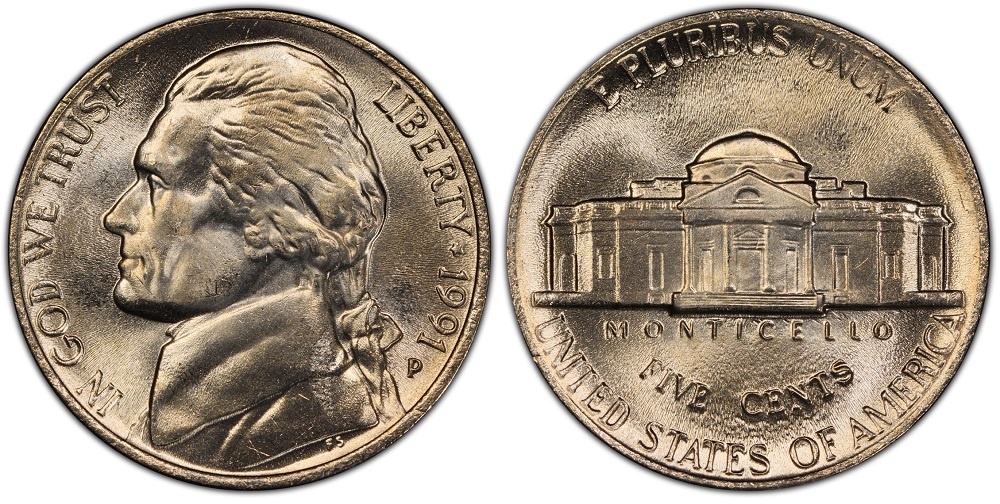
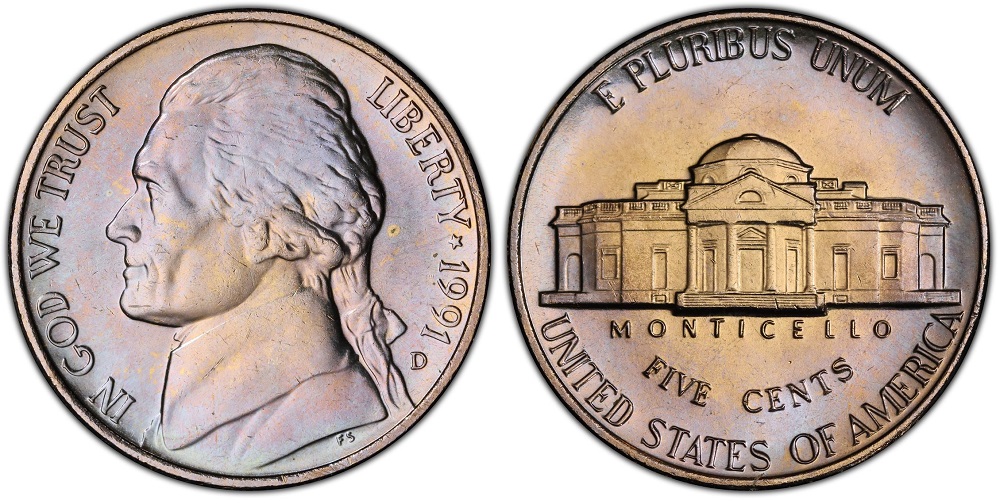
A 1991-P nickel in pristine MS-68 condition sold for $1,900 — yet most worn examples from pocket change are worth just five cents. The Full Steps strike designation and a handful of dramatic mint errors are what separate face value from genuine collector premiums. Use this guide and free calculator to find out exactly where your coin stands.
The Full Steps designation is the single biggest value driver for 1991 Jefferson nickels. Use this checker to find out if your coin qualifies — before you decide whether professional grading is worth the cost.
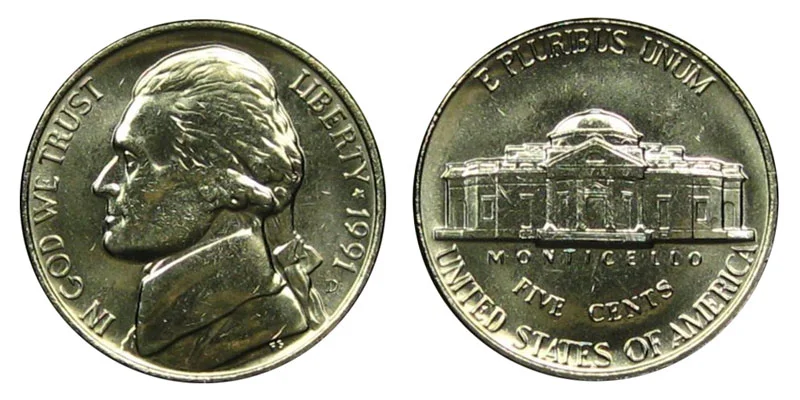
One or more step lines on Monticello's staircase show interruptions, bridges, or blending. Most 1991 nickels fall here regardless of mint. Value stays at face value when worn; modest $5–$50 uncirculated.
All five (or six) horizontal step lines run completely unbroken across the full width of Monticello's base. No bridges, no weak points. A 1991-P MS-67 FS brought $950 on eBay in June 2022. Even MS-65 FS examples regularly exceed $50–$150 at auction.
Check all 4 features that apply to your coin's reverse:
Type a description of what you see on your coin below. Mention the mint mark, any numbers visible on the step area, signs of wear, or anything unusual. The tool will analyze your description and give you a tailored assessment.
Now that you've described your coin, get an instant estimated value by mint mark, condition, and errors — it only takes 30 seconds.
Use the Free Value Calculator →Answer three quick questions — mint mark, condition, and errors — and get an instant estimated value range backed by real auction data.
Check near the date on the front of the coin.
Check for wear on Jefferson's cheekbone and Monticello's columns.
Check all that apply.
Not sure about your coin's mint mark or condition yet? There's a 1991 Nickel Coin Value Checker with photo upload that lets you upload photos and get an AI-based estimate without having to identify those details yourself first.
With over one billion 1991 nickels produced across two mints, quality control could not catch every mistake. The varieties below range from collectible doubling to genuinely rare wrong-metal strikes. Each card covers what the error looks like, why collectors want it, and what you should expect to pay or receive at auction.
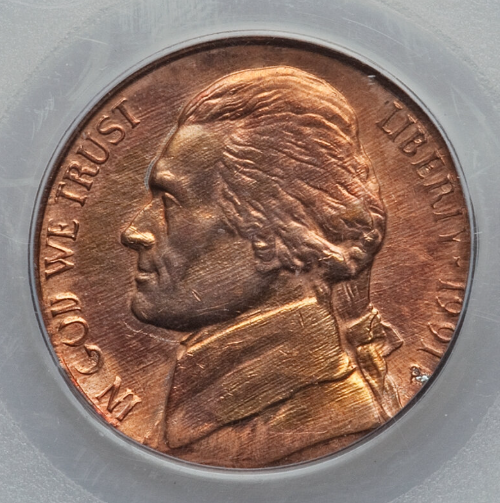
This is the crown jewel of 1991 nickel errors. It occurs when a blank intended for a different denomination — most famously a Lincoln cent planchet — enters the coining chamber and receives a nickel die impression. The result is a coin struck with Jefferson nickel dies but on foreign metal, creating a dramatic hybrid that clearly does not belong.
Visually, a 1991-P struck on a Lincoln cent planchet is immediately wrong: it measures roughly 19.05 mm across versus the correct 21.2 mm of a standard nickel, and it weighs approximately 2.5 g rather than the correct 5.0 g. The design will appear compressed or partially off-rim, since the smaller planchet cannot accommodate the full die impression. The copper color is often a giveaway in hand.
Collectors prize wrong-planchet errors because they represent a complete failure of multiple quality-control steps at the mint. Two documented auction results confirm strong demand: a piece graded NGC MS-64 realized $1,080 at Heritage Auctions in 2023, and a comparable example brought $432 at Heritage in 2019. Given over a billion coins struck, the number of surviving wrong-planchet errors is likely in the single digits.
An off-center strike happens when the planchet is not fully seated beneath the dies at the moment of impact. The misaligned blank receives a partial impression, leaving a blank, unstruck crescent on one side while the opposite side shows the design crowded toward the rim. The severity is measured as a percentage: a 50% off-center strike, where exactly half the design is missing, is the most dramatic and most sought-after.
Identifying an off-center 1991 nickel is straightforward. The coin will look "lopsided" — Jefferson's portrait may be pushed toward one edge, or Monticello will be squeezed against one rim with open blank metal on the other side. Minor 5–10% off-center strikes are relatively common on modern nickels, while major examples showing 30% or more offset are uncommon. The date must still be visible to command maximum premium.
Minor off-center strikes on 1991 nickels typically fetch $10–$30 in retail listings. Dramatic examples showing 30–50% offset with the date clearly visible have appeared in retail listings ranging from $36.40 to $56.00. A 50% off-center example with a full, legible date would exceed the top of this range. The error type is well-documented across multiple modern Jefferson nickel dates, giving buyers confidence in attribution.
The Doubled Die Reverse (DDR) results from a working die being hubbed (impressed) twice at a slight rotational or translational offset. Every coin struck from that die carries the doubled image embedded in the metal. This is a true mechanical variety, distinct from the more common Machine Doubling or Die Deterioration Doubling that leave flat, shelf-like traces — true DDR shows rounded, raised secondary images.
At least six DDR varieties for the 1991-D nickel have been cataloged by Variety Vista, the leading online reference for Jefferson nickel die varieties. They are designated DDR-001 through DDR-006 using Variety Vista's alpha-numeric system (e.g., "1-R-II-C"). The doubling appears primarily on reverse lettering — most visibly on "E PLURIBUS UNUM" and "UNITED STATES OF AMERICA" — and is confirmed under a 10× loupe. Stronger varieties show separation clearly; weaker ones require careful examination to distinguish from mechanical or die deterioration doubling.
These varieties are considered minor compared to headline errors like wrong planchets, but they carry genuine collector premiums in higher grades. A strongly doubled, well-certified high-grade example can exceed $60. Because the varieties are not yet widely publicized in mainstream price guides, cherry-pickers frequently find underpriced examples in dealer bins and on auction platforms — giving the DDR a "best kept secret" status among Jefferson nickel specialists.
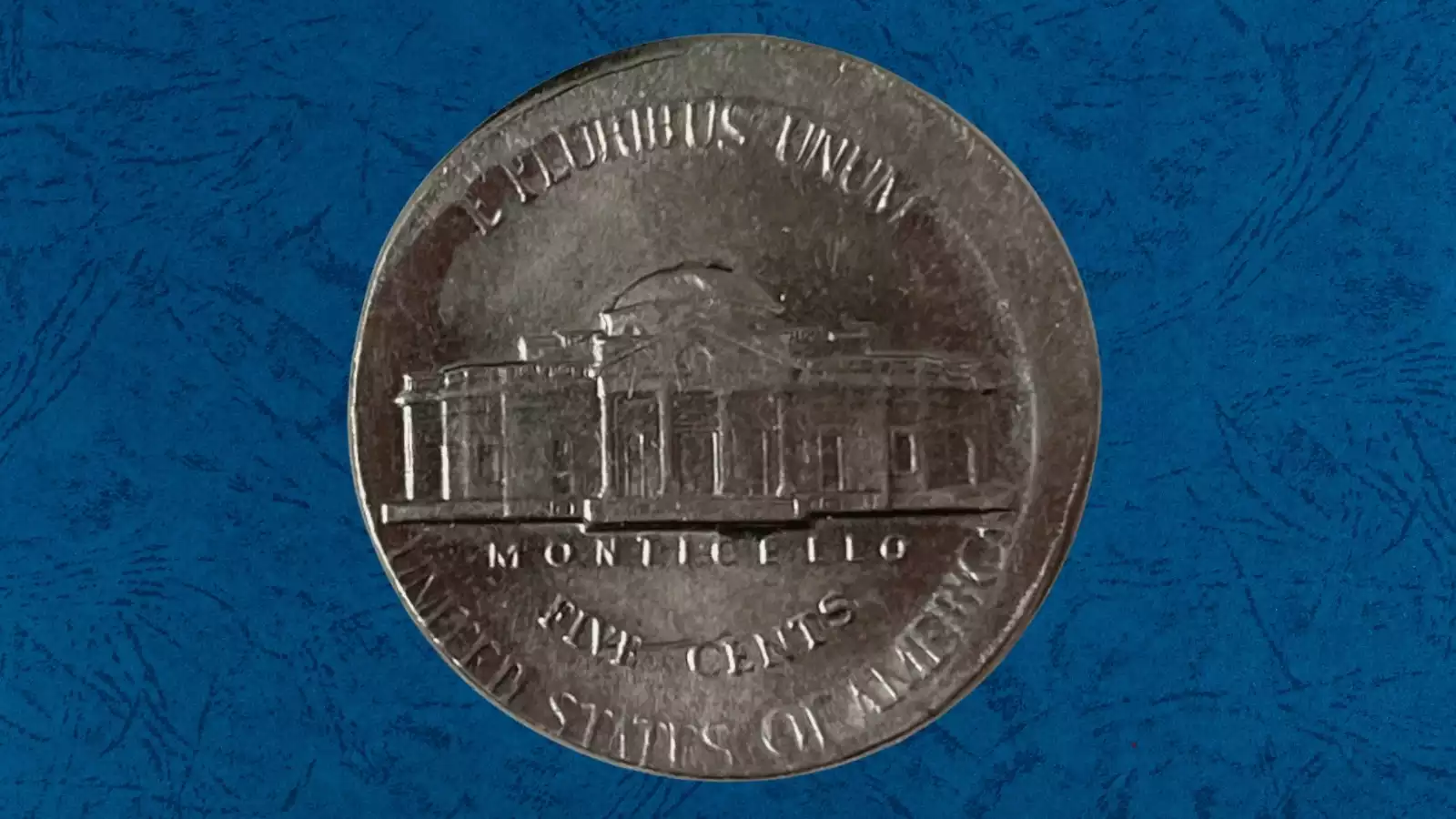
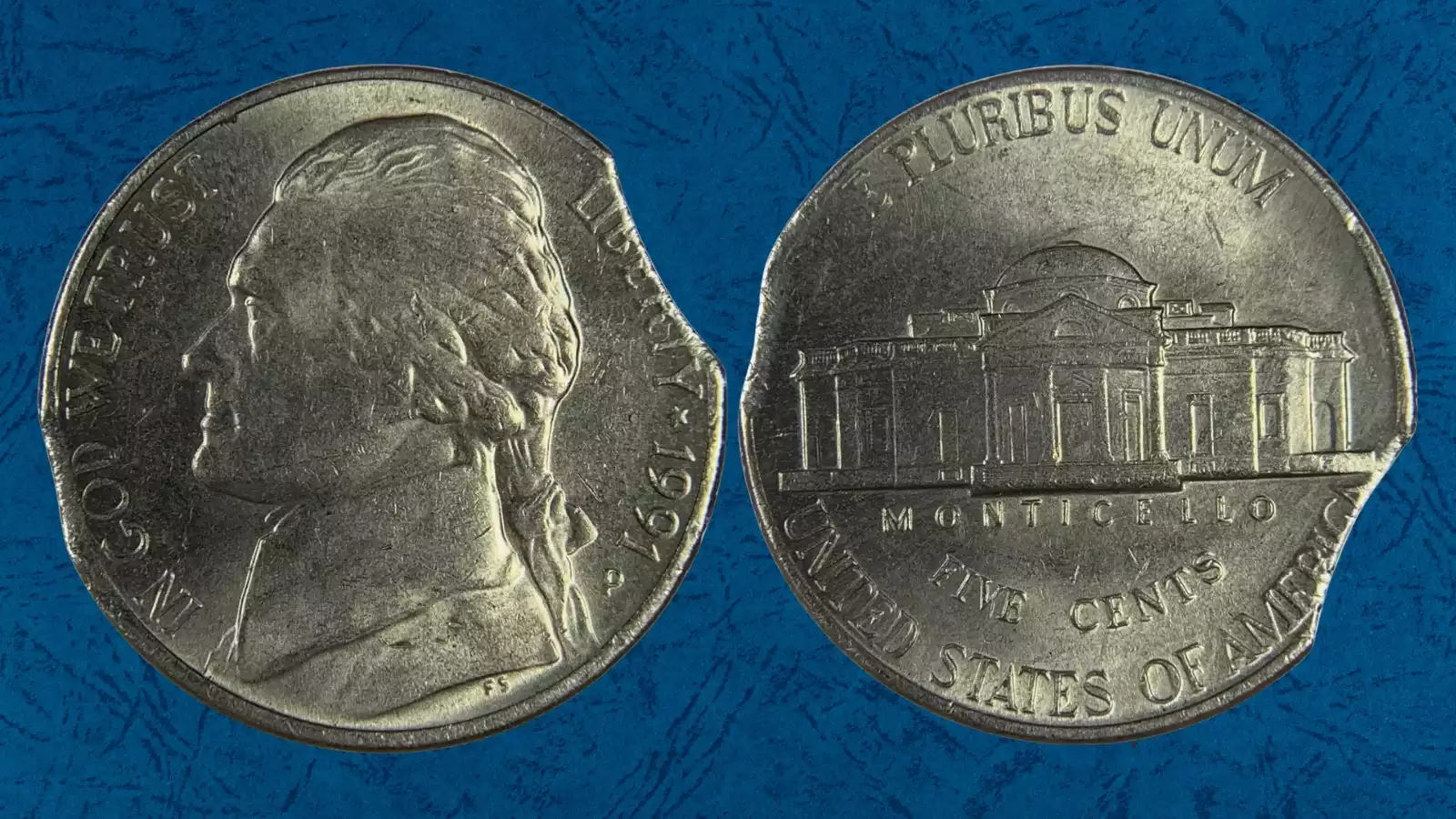
A clipped planchet error occurs during the blanking process, before the coin is ever struck. When the cutting punch that punches circular blanks from the metal strip overlaps a hole already punched in the same strip, it removes a crescent-shaped portion of the new blank. The resulting planchet is pie-shaped rather than perfectly round, and the coin struck from it bears a smooth curved indentation along one section of its rim.
On a 1991 Jefferson nickel, a curved clip is the most common variety — it leaves a smooth, arching concavity along the coin's edge, typically between 5 mm and 12 mm in span. Straight clips, which occur when the punch cuts into the edge of the metal strip itself, are rarer and command a higher premium. The Blakesley effect — a weakness in the design opposite the clip — is diagnostic of a genuine clip and not post-mint damage. Under magnification, the clipped edge will be smooth and slightly rounded, lacking the jagged characteristics of a physical cut.
Value depends heavily on clip size and drama. Minor clips showing only 5% of the coin's circumference sell for $15–$25. A large, dramatic clip showing 20% or more of the rim removed, with the Blakesley weakness clearly visible opposite it, can bring $50–$75 or more when certified. Both Philadelphia and Denver examples have appeared in retail market listings at these price points.
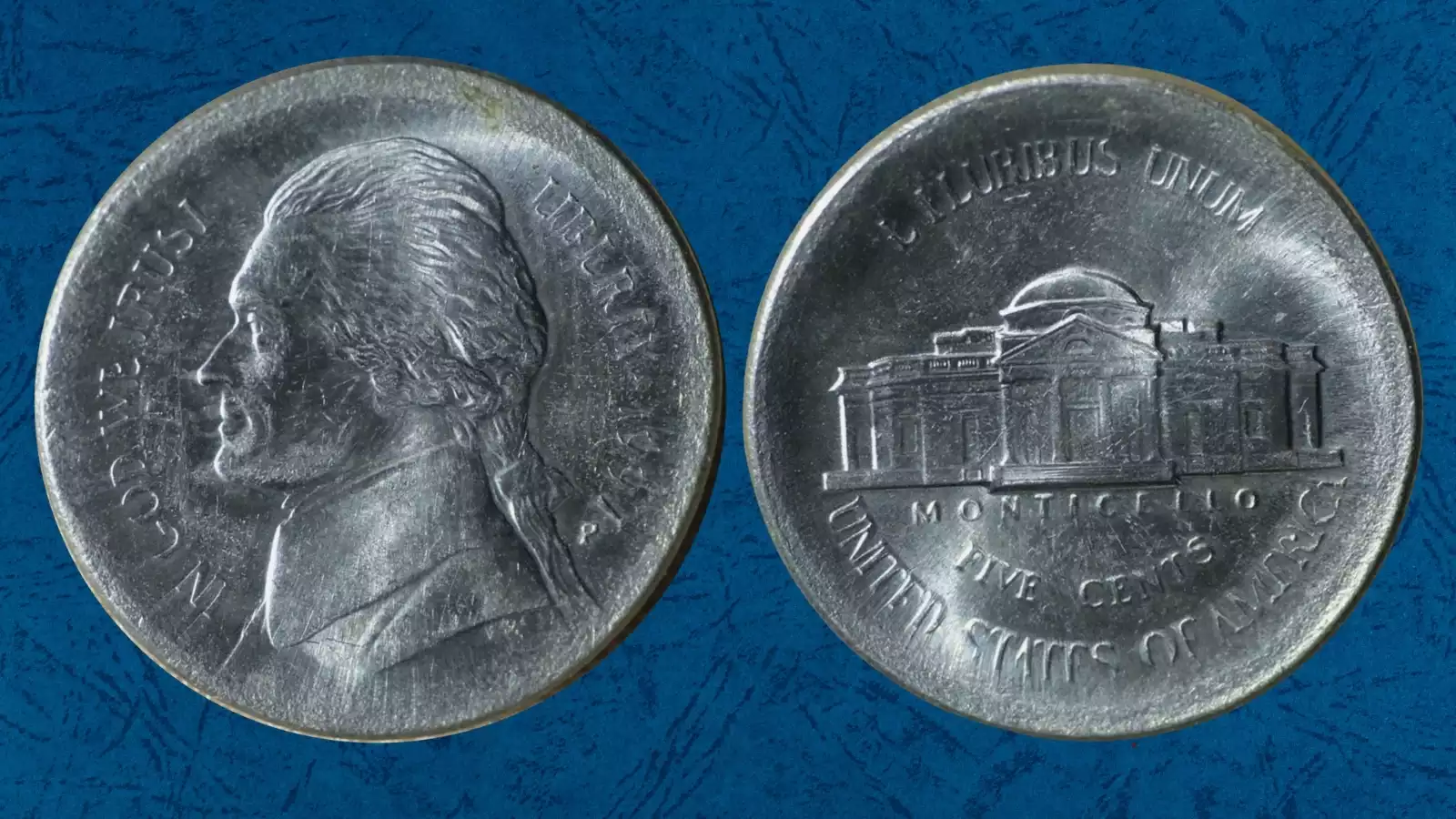
A broadstruck error occurs when the collar die — the ring surrounding the coin blank that constrains metal flow and creates the coin's proper circular shape and raised rim — fails to engage fully during the strike. Without the collar's restraint, the metal spreads outward beyond the normal 21.2 mm diameter, and no proper rim is formed. The result is a coin that is wider, flatter, and rimless compared to a normal nickel.
On a 1991 Jefferson nickel, a broadstruck example is immediately recognizable: the coin will be larger in diameter than normal (often 22–24 mm), with a flat, rimless edge all the way around. The design itself is often quite sharp because the full striking pressure was applied — it simply was not constrained. The obverse portrait of Jefferson and the reverse Monticello may appear complete and well-struck despite the irregular shape. There are no diagnostic doubling or shift features to look for beyond the distinctive rimless, oversized profile.
Broadstrikes on 1991 Jefferson nickels appear regularly in collector markets and are among the more accessible modern nickel errors. Values depend on drama — a minor broadstrike with barely-expanded diameter fetches $15–$25. A dramatic broadstrike with 2–3 mm of visible expansion beyond normal diameter, sharp design, and no significant contact marks, can bring $30–$50 or more when certified. Die clash traces occasionally appear on broadstruck pieces, which can add incremental interest. Both P and D mint broadstrikes have been documented across multiple collector platforms.
Run it through the value calculator to get an instant estimated price range — takes under a minute and requires no signup.
Calculate My Error Coin's Value →This table covers all major 1991 Jefferson nickel varieties across four condition tiers. For a deeper identification walkthrough with this year's complete in-depth 1991 Jefferson nickel guide and recognition reference, visit CoinValueApp's companion page. Highlighted rows: 🟡 Full Steps (signature variety); 🔴 Wrong Planchet error (rarest).
| Variety | Worn / Circulated | Uncirculated (MS-63–64) | Gem (MS-65–66) | Superb Gem (MS-67+) |
|---|---|---|---|---|
| 1991-P Standard | Face value | $5 – $15 | $15 – $180 | $180 – $1,900 |
| 🟡 1991-P Full Steps (FS) | Face value | $10 – $22 | $50 – $384 | $384 – $950 |
| 1991-D Standard | Face value | $5 – $10 | $14 – $60 | $60 – $403 |
| 1991-D Full Steps (FS) | Face value | $10 – $20 | $20 – $100 | $100 – $396 |
| 1991-S Proof DCAM | N/A | N/A | $2 – $15 | $40 – $145 |
| 🔴 Wrong Planchet Error | N/A | $432+ | $600 – $1,080+ | Auction only |
Values are approximate ranges based on PCGS, NGC, Heritage Auctions, and eBay completed sales data. Actual results vary by specific grade, surface quality, and market conditions.
📱 CoinKnow lets you snap a photo of your 1991 nickel and get an instant value estimate on the go, without needing to look up a price guide — a coin identifier and value app.
| Mint | Mint Mark | Strike Type | Mintage | Survival Notes |
|---|---|---|---|---|
| Philadelphia | P | Business Strike | 614,104,000 | Common in all grades through MS-66; MS-67+ extremely scarce; one MS-68 (NGC) known |
| Denver | D | Business Strike | 436,496,678 | Common through MS-65; tops out at MS-66; Full Steps designation adds minimal premium vs. P-mint |
| San Francisco | S | Proof (DCAM) | 2,867,787 | ≈99% survival; sold in annual proof sets only; PR-70 DCAM is condition rarity only |
| Total (all mints) | 1,053,468,465 | Over one billion coins — highest combined mintage of any 1991 U.S. coin denomination relative to face value | ||
Metal: 75% Copper, 25% Nickel (cupronickel) | Weight: 5.00 g | Diameter: 21.2 mm | Edge: Plain | Designer: Felix Schlag (obverse) | Series: Jefferson Nickel, Type 1 (Original Design)
Grade determines value for 1991 nickels more dramatically than almost any other modern coin. A one-grade jump from MS-66 to MS-67 on the 1991-P can mean the difference between $50 and $180. Here's how to place your coin in the right tier.
Jefferson's cheekbone, hairline above the ear, and the bow of his coat are flat and featureless. Monticello's columns may still show definition but the steps are completely flat. Worth face value — five cents. No numismatic premium exists at this level for 1991 nickels.
High points show slight friction but design detail remains sharp. Light luster may survive in protected areas. Steps are visible but will not qualify as Full Steps. Still worth face value to a small premium (under $1 for most examples). Only significant if a dramatic error is also present.
No wear whatsoever; original cartwheel luster intact. Surface contact marks from bag storage are present and reduce the grade. Steps may or may not be complete. Value ranges from $5–$22 depending on grade. An MS-64 with Full Steps was sold on eBay in early 2026 for around $23.
Exceptional surface quality with minimal contact marks and vibrant luster. MS-65 FS coins consistently bring $50–$150. MS-67 non-FS reached $180; MS-67 FS realized $950. The lone NGC MS-68 sold for $1,900. These grades require professional certification to establish value with buyers.
🔎 CoinKnow can help you match your coin's surface detail against graded reference images when assessing condition at home — a coin identifier and value app.
Where you sell matters as much as what you have. A wrong-planchet error will always do best at a major auction house; a modest MS-65 FS example sells fine on eBay. Here's where each type of 1991 nickel finds its best market.
The premier venue for high-value 1991 nickels. Both documented wrong-planchet sales ($1,080 and $432) cleared Heritage. For any coin worth over $200, Heritage's bidder pool of serious collectors will almost always outperform other platforms. Submit through their online consignment portal; fees run 15–20% seller's commission. Best for MS-67+, Full Steps top-pops, and any major mint error.
The broadest buyer base for mid-range 1991 nickels. The MS-67 FS record of $950 and the MS-68 non-FS record of $494.95 were both set on eBay. For coins in MS-65 FS to MS-67 range, the platform's deep audience and completed recently sold prices on 1991-P Jefferson nickel listings give you solid price discovery. Use auction format for potentially rare examples; "Buy It Now" with best offer for more common grades.
Fastest option for quick cash, but expect 30–50% below retail for common 1991 nickels. A local dealer is best for worn or lightly uncirculated examples where shipping and auction fees would eat into any small premium. For Full Steps or error coins, it's worth getting multiple bids — dealers vary widely on specialty items like Jefferson nickel varieties.
Good for collector-to-collector sales of mid-grade examples. The Jefferson nickel collecting community is active and knowledgeable — members recognize Full Steps designation and will pay fair prices. Lower fees than eBay (typically just PayPal). Best suited for MS-64 to MS-66 FS examples where you want collector premium without auction commission.
For any 1991 nickel you believe is MS-65 or higher — especially with Full Steps — professional grading by PCGS or NGC pays for itself. Grading fees start around $20–$50 per coin. An ungraded MS-65 FS might sell for $30–$40; the same coin in a PCGS or NGC slab consistently brings $50–$150+. For error coins and any coin potentially MS-67 or higher, grading is essential. Submit bulk to lower per-coin fees.
Most circulated 1991 nickels are worth face value — five cents. Uncirculated examples start around $5–$15 at MS-63 to MS-65. The real premiums come from the Full Steps (FS) designation, where MS-65 FS coins reach $50–$150 and an MS-67 FS sold for $950 in 2022. The all-time record for a non-error 1991-P is $1,900 for an NGC MS-68 example.
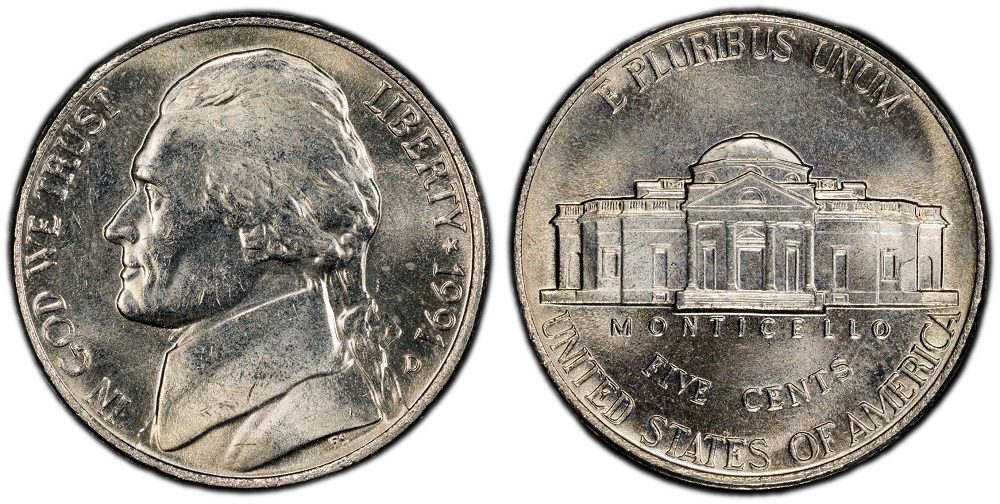
Full Steps (FS) is a special designation awarded by PCGS and NGC when the staircase at the base of Monticello on the reverse shows at least five complete, uninterrupted horizontal lines. A sharp, well-centered strike is needed to achieve this. Even one tiny break or "bridge" in the step lines disqualifies the coin. FS examples are significantly scarcer than regular uncirculated coins and command strong premiums.
The most valuable documented 1991 nickel error is the wrong planchet / double denomination strike — a 1991-P nickel struck on a Lincoln cent planchet. One example graded NGC MS-64 sold for $1,080 at Heritage Auctions in 2023. A similar piece in a slightly lower grade brought $432 at Heritage in 2019. These errors are extremely rare given the billion-plus coin mintage.
Generally no. The 1991-P holds the higher auction ceiling ($1,900 for MS-68), while the 1991-D peaks around $403 for an MS-66 at Heritage Auctions. However, the Denver coin's strike quality was actually more consistent in 1991, meaning the Full Steps designation adds less of a premium for Denver compared to Philadelphia. Both are worth face value in circulated grades.
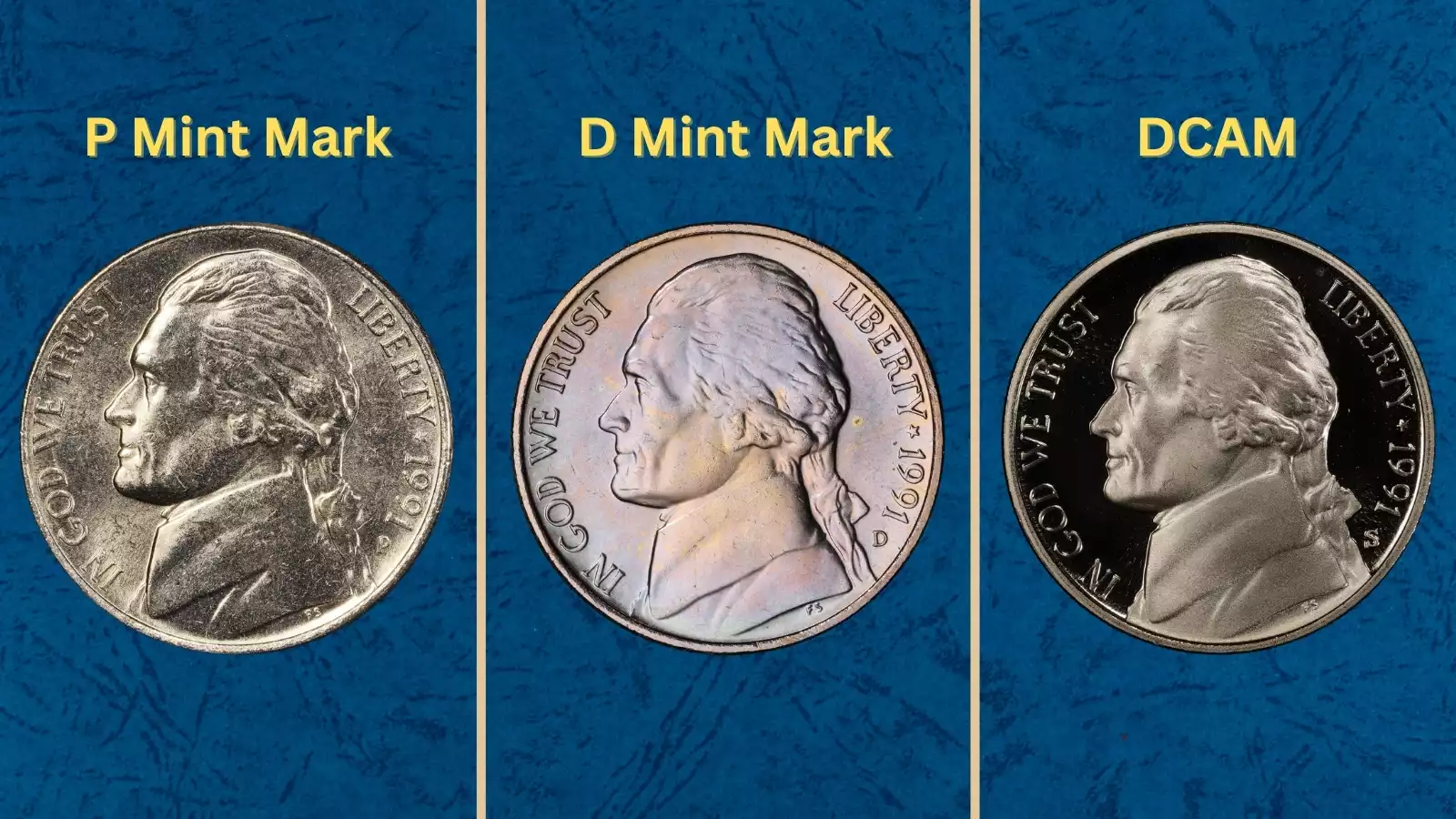
The mint mark on a 1991 Jefferson nickel is located on the obverse (front), to the right of Jefferson's portrait near the date. A "P" means Philadelphia (614 million struck), "D" means Denver (436 million struck), and "S" means San Francisco — but S-mint coins from 1991 are proof strikes only, sold in collector sets, not found in pocket change. Use a 5× or 10× loupe to read it clearly.
Over one billion 1991 nickels were produced across three mints. Philadelphia struck 614,104,000 business strike coins, Denver produced 436,496,678, and San Francisco minted 2,867,787 proof coins exclusively for collector sets. The massive combined mintage is why circulated examples are worth face value — there is simply no scarcity in worn grades.
It is possible but unlikely. Any coin you pull from circulation will almost certainly be worn to face value. However, if you find a 1991 nickel that never circulated — perhaps from an old roll or mint set — it could be worth a small premium uncirculated. True Full Steps examples or error coins occasionally turn up but require careful examination with a magnifying glass before any value claim can be made.
The 1991-S proof nickel, struck only at San Francisco for collector sets, is worth about $2–$5 in average proof condition (PR-65 to PR-68 DCAM). Near-perfect PR-69 DCAM examples sell around $5–$15. The top grade, PR-70 DCAM, has brought $40–$145 at auction. The PCGS Price Guide baseline for PR-70 DCAM is $40. With nearly 99% of the 2,867,787 proofs still surviving, true scarcity is minimal.
At least six Doubled Die Reverse (DDR) varieties have been cataloged for the 1991-D nickel by Variety Vista, designated DDR-001 through DDR-006. The doubling is visible on reverse lettering, particularly "E PLURIBUS UNUM" and "UNITED STATES OF AMERICA," under a 10× loupe. These are considered minor collectible varieties. High-grade certified examples with strong doubling can sell for $60 or more over standard values.
Never clean a coin. Cleaning removes the original mint luster and introduces fine hairline scratches visible under magnification, which immediately reduces the coin's grade and therefore its value. A cleaned coin that would have graded MS-65 uncirculated can be downgraded to "Details" status by PCGS or NGC, often cutting its value in half or more. Collectors and grading services specifically look for and penalize any evidence of cleaning or polishing.